4 min read

The Quiet Revolution: How AI Is Reshaping Australian Planning Approvals

The Quiet Revolution: How AI Is Reshaping Australian Planning Approvals

In May 2026, the Commonwealth Government committed more than half a billion dollars over four years to modernise Australia's environmental approval system. The shorthand inside the policy community has been blunt: "$500 million for planning AI."

It's a useful shorthand because it captures, in one line, what is genuinely new about this reform package. The technology to deliver the long-promised improvements has matured at the same time the political consensus has formed. Planning is being deliberately rebuilt around data, automation, and decision-support.

Here's what the next 24 months look like - and why everyone with a stake in NSW property should be paying attention.

What's actually changing

The Budget commits more than $500 million over four years across a set of complementary measures:

  • $105.9 million for environmental approval data and AI modernisation - the backbone the rest of the reform depends on.
  • $47.6 million for state bilateral agreements that reduce federal-state duplication.
  • $36.9 million to scale the Nature Repair Market into a tradeable federal offset currency.
  • $26.4 million for bioregional plans and strategic assessments - the "go" and "no-go" zones for housing, renewables, and critical minerals.
  • A new National Environmental Protection Agency (NEPA) standing up from 1 July 2026.

The Productivity Commission estimates that streamlining the environmental approval pathway alone could remove around $6.9 billion a year of regulatory burden. EPBC on-time decisions sit at 78% today; the reform target is 95% by 2025-26.

The pattern across all of this is the same: standardise the rules, integrate the data, and make the same evidence available to regulators, councils, and proponents at the same time.

Why AI specifically

Planning reform isn't new. What's new in 2026 is that several enabling capabilities have matured at once.

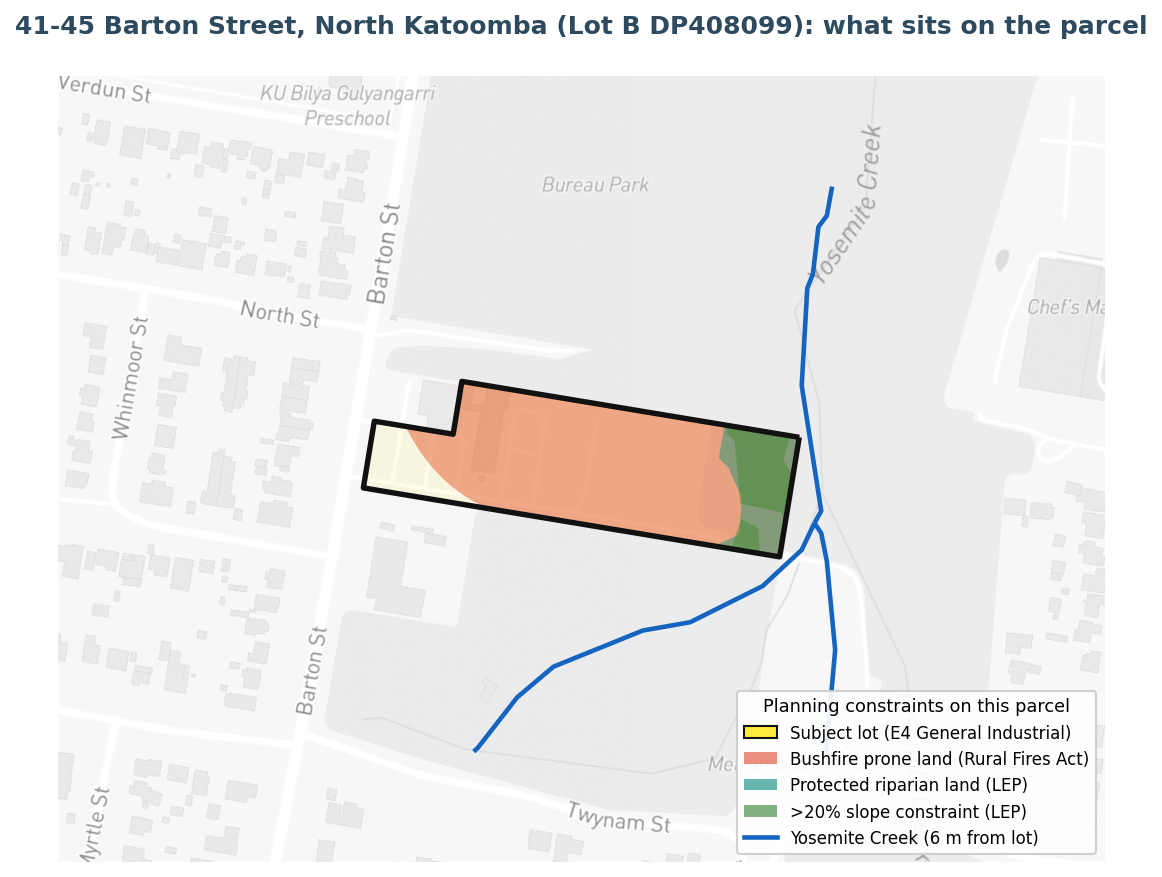
Spatial data integration. Australia now publishes high-quality, machine-readable spatial datasets covering cadastre, vegetation, threatened species, infrastructure, hazards, heritage, and land use. NSW alone exposes more than 140 separately-maintained authoritative layers via the SEED catalogue and BioNet. Joining a single property to its full constraint footprint used to be a multi-day specialist task. With modern spatial computing, it's a sub-second query.

Natural-language access to regulation. Environmental legislation and planning instruments are textual. Modern language models can extract structured rules from those documents and answer "what does this overlay actually require?" at machine speed - if they're built carefully, and if the answer is always traced back to a source.

Probabilistic credit and offset assessment. Biodiversity credits and stewardship values are multi-variable problems. Modern systems can quantify uncertainty - showing the range of defensible numbers and the inputs that drive variance - which is more useful to a landholder or developer than any single estimate that pretends to more certainty than it has.

These aren't speculative capabilities. They're operating in commercial planning workflows in Australia today.

Where does your property sit in all this? Search it free and see the constraint and opportunity flags in seconds.

Check your property, free

What "good" planning AI looks like

The risk in any AI procurement is that the system gives fluent answers that are wrong. In a planning context, "wrong" can mean a development going ahead on land that should have been protected, or a property being assessed as substantially more or less valuable than it actually is. The reputational and legal cost of either failure is severe.

A planning AI system worth using should pass six tests:

  • Source-anchored. Every output references the dataset, instrument, or precedent it draws on - with version and date. If a number changes, you should be able to see why.
  • Boundary-aware. The system reports uncertainty honestly. A confident wrong answer is worse than a humble accurate one.
  • Human-in-the-loop. The technology augments qualified people. Final approvals, value assessments, and recommendations involve professional judgement and accountability that no current system should be carrying alone.
  • Auditable. Every conclusion is reproducible from the inputs. A regulator or court should be able to see the chain of reasoning end-to-end.
  • Regulator-aligned. Whatever methodology a private platform uses, it should sit close enough to the regulator's published standards that an output translates cleanly to the assessment a regulator would produce.
  • Maintained. Planning datasets and policies change constantly. A planning AI is a maintenance commitment, not a one-time build.

Buyers and procurement teams who hold AI offerings to these tests will get a markedly better outcome than those who only ask about features.

What it means for each side of the market

Developers and proponents. Faster approvals are coming - but not for everyone. Bioregional plans will create areas where projects advance with light-touch assessment, and areas where they will be much harder to advance than today. Pre-acquisition due diligence is becoming a competitive advantage, not a back-office cost.

Landowners. The same data revolution that helps developers see constraint risk also helps landowners see opportunity. Properties that carry priority vegetation, threatened-species habitat, or sit inside a "go" zone for housing or renewables will increasingly carry an additional measurable value beyond their agricultural or residential price. Knowing that value puts you in a stronger position - whether you're selling, entering a Biodiversity Stewardship Agreement, or holding for future development.

Local councils. Staff backlogs and shortages are real. AI-assisted constraint mapping and consistency-checking are productivity multipliers, provided the system can produce a clean evidentiary record when a decision is challenged.

Consultants and planners. AI doesn't replace the work; it changes its shape. Routine constraint mapping becomes a baseline output, not a billable engagement. The premium shifts to interpretation, on-ground verification, and the structuring of negotiations - the parts of the job that compound rather than compete with automation.

What's next

Federal-state harmonisation, bioregional zoning, and transparent shared data make the addressable problem larger and more tractable at the same time. The $500 million commitment is the first instalment of a longer reform cycle.

For landholders deciding whether to develop, sell, or hold; for developers deciding which sites to acquire; for the consultants and advisors working across all of them, the next 24 months will be the most consequential planning-reform window in two decades.

The opportunity is to engage with the transition early - and to expect high standards from the AI tools that promise to help.

Read the full whitepaper

The full MapCheck Planning AI Whitepaper covers the Budget package in detail, the six tests for planning AI, the risks of the transition, and a two-year horizon to mid-2028. Free, delivered to your screen after one field.


This article summarises a longer whitepaper. It is general information drawn from publicly available Government documents and is not legal, planning, or financial advice. Specific decisions should be verified with appropriately qualified professionals.

MapCheck is a NSW property intelligence service that pulls 140+ NSW Government datasets into one plain-English property report, delivered on demand. From AU$499. Run your property at mapcheck.com.au/check-your-property.

Try MapCheck free

See what's on your land

Type an NSW address or Lot/DP - see live constraint flags before you commit to a report.

Run a free check →
No account required
Ready to check your property?

Order your MapCheck report

140+ NSW datasets · PDF on demand · No account required.

Order LCCA - AU$499 → Order PEA - AU$1,499 → Order Education - AU$2,499 →
Incl. GST · Stripe secure
Why MapCheck
140+
NSW Government datasets
97.2%
Validated accuracy
on demand
Report turnaround
The Quiet Revolution: How AI Is Reshaping Australian Planning Approvals

The Quiet Revolution: How AI Is Reshaping Australian Planning Approvals

In May 2026, the Commonwealth Government committed more than half a billion dollars over four years to modernise Australia's environmental approval...

Read More
Pre-Purchase Environmental Assessment for Hobby Farm Development

Pre-Purchase Environmental Assessment for Hobby Farm Development

Client James T., Consultant and Hobby Farmer Location Northern Tablelands, NSW Turnaround 2 business days Product Property & Environmental Assessment (PEA)

Read More
Maximizing Biodiversity Stewardship Value for Rural Landowners

Maximizing Biodiversity Stewardship Value for Rural Landowners

Client Multi-generational farming family, NSW Property 120+ hectares of high-value vegetation Counterparty Renewable infrastructure developer seeking...

Read More
The Hidden Threat — What NSW Farmers Really Need to Know About NVR Mapping

3 min read

The Hidden Threat — What NSW Farmers Really Need to Know About NVR Mapping

Most NSW farmers reading their Native Vegetation Regulatory (NVR) map look at the coloured zones and stop there. Category 1 unregulated, Category 2...

Read More
How Biodiversity Risk Reports Help Navigate NSW SEPP Requirements for Land Development and Farming Operations

4 min read

How Biodiversity Risk Reports Help Navigate NSW SEPP Requirements for Land Development and Farming Operations

Understanding the complex web of NSW biodiversity regulations can be challenging for property owners, whether you're planning residential development...
Read More
Native Vegetation Laws in NSW — What Property Owners Need to Know

4 min read

Native Vegetation Laws in NSW — What Property Owners Need to Know

Native vegetation in NSW sits under two pieces of legislation that work in tandem: the Biodiversity Conservation Act 2016 (BC Act) and the Local Land...

Read More